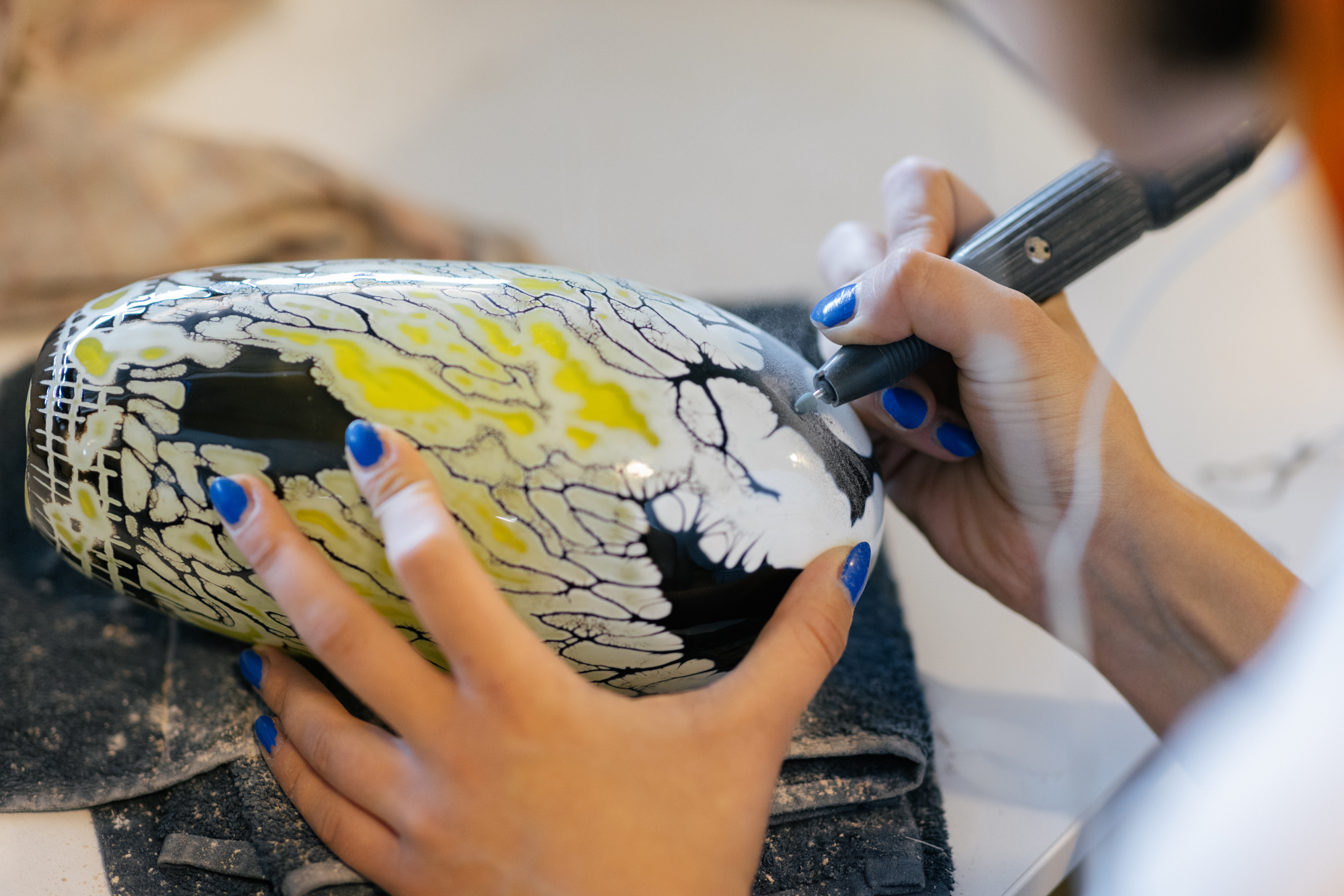
The master glassblowers in Glasriket have always been at the forefront, demonstrating tremendous
willingness to push the boundaries of glass in collaboration with designers. Here at
, we’re offering you a quick lesson and taking a closer look at Graal and Ariel.
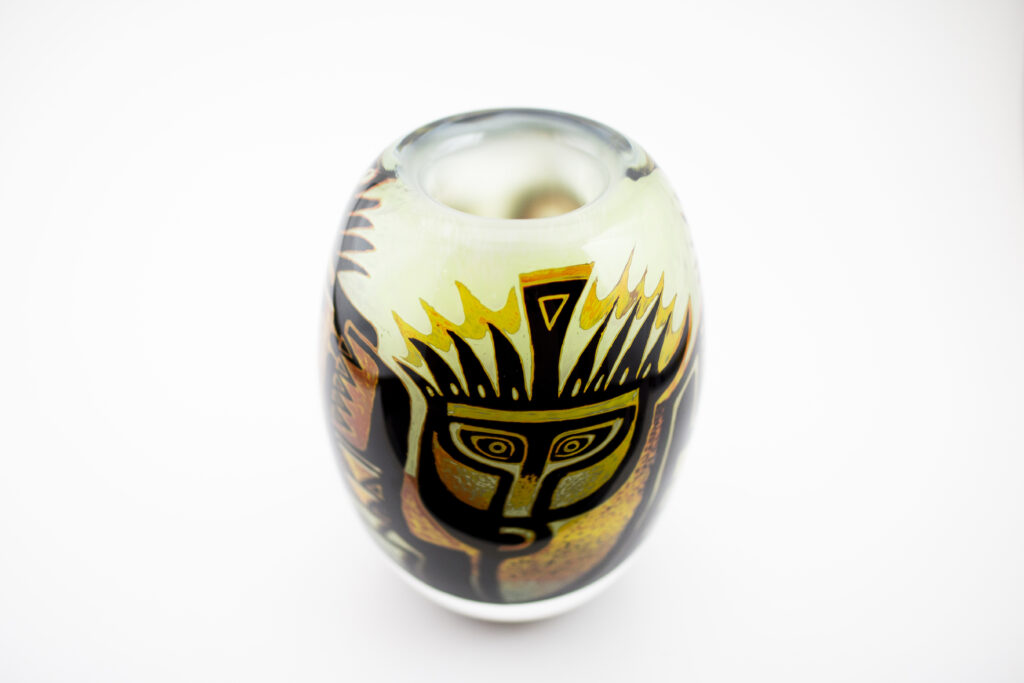
Grail
Designer: Master glassblower Knut Bergqvist.
Origin: 1916 in Orrefors.
Distinguishing feature: Glass in which the pattern is embedded in the molten glass.
Here’s how it works: The molten glass collected in the glass pipe is covered with layers of colored glass. Once it has cooled, it is processed through engraving, grinding, sandblasting, painting, or decals before being reheated, covered with clear glass, and blown into its final shape.
Micke Johansson explains: “The hardest part about graal is achieving harmony in the pattern. The heat has to be even, and you have to keep an eye on the pattern the whole time so it doesn’t get warped. You blow, look, blow…
Plus, you have to rotate the pipe equally in both directions; otherwise, the design will twist. The beauty of it is that you can create such wonderful images. The artists can truly bring their visual world to life on the glass!”
Fun fact: The name “Graal” comes
from the Latin word “gradalis,” which means
bowl or goblet. Ariel, Slipgraal, Ravenna
, and Kraka are all based on Knut Bergqvist’s “Graal” technique.
Ariel
Creators: Somewhat unclear, but both master glassblowers Gustaf Bergkvist and Knut Petersson, as well as artists Edvin Öhrström and Vicke Lindstrand, were involved in developing the technique.
Origin: 1937 in Orrefors.
Characteristics: Air bubbles that form patterns inside the glass.
How it’s done: The pattern is sandblasted, ground, or engraved into the colored layer of the glass blank. When the glass is reheated and covered with a layer of clear glass, air bubbles are trapped within the recesses.
Micke Johansson explains: “The hardest part here is maintaining a nice air pattern. The hotter the glass gets, the less air there is. If you make even a small mistake, the air disappears, so you have to be 100 percent focused the whole time! I like the ‘ariel’ technique because the designs turn out so ethereal and ‘glassy.’ It turns out really beautiful. That’s glass at its best!”
Fun fact: The name comes from Ariel, the air spirit in Shakespeare’s play “The Tempest”